Showing posts with label Thor. Show all posts

Thursday, November 14, 2013

3 TOTALLY INSANE BUT COMPLETELY PLAUSIBLE THEORIES FOR WHAT THE END OF "THOR: THE DARK WORLD" MEANS

DO NOT READ THIS IF YOU HAVEN'T SEEN THOR: THE DARK WORLD. HERE BE SPOILERS!

Thor: The Dark World ended with the biggest plot twist the MCU has ever seen: Thor's nefarious brother Loki staged his own death and is now sitting on the throne of Asgard by wearing his father as a Halloween costume. The scene may be shocking, but it doesn't so much as hint at Loki's future plans beyond, "order the guards to play ultimate frisbee for my own amusement."

For fans of the comics, however, Loki's reveal as the king of Asgard - coupled with the sudden inclusion of the "infinity stones" during the mid-credits scene - was a moment worth soiling oneself over.

So what does Benicio Del Toro in clown makeup have to do with Loki doing the whore-sit on the throne? Well, does anybody remember the ugly guy who showed up at the end of the mid-credits scene of The Avengers?

The one who looks like a potato that got beaten with a rake?

That purple monstrosity above is known as Thanos, and here's what we know so far:

1. Thanos gave Loki the scepter.

2. The scepter has a stone in it that can control minds.

3. Thanos sent Loki and the Chitauri army to Earth to get the Tesseract.

4. Loki was told that if he failed, he would "long for something sweet as pain."

5. Loki failed spectacularly.


OR DID HE?!


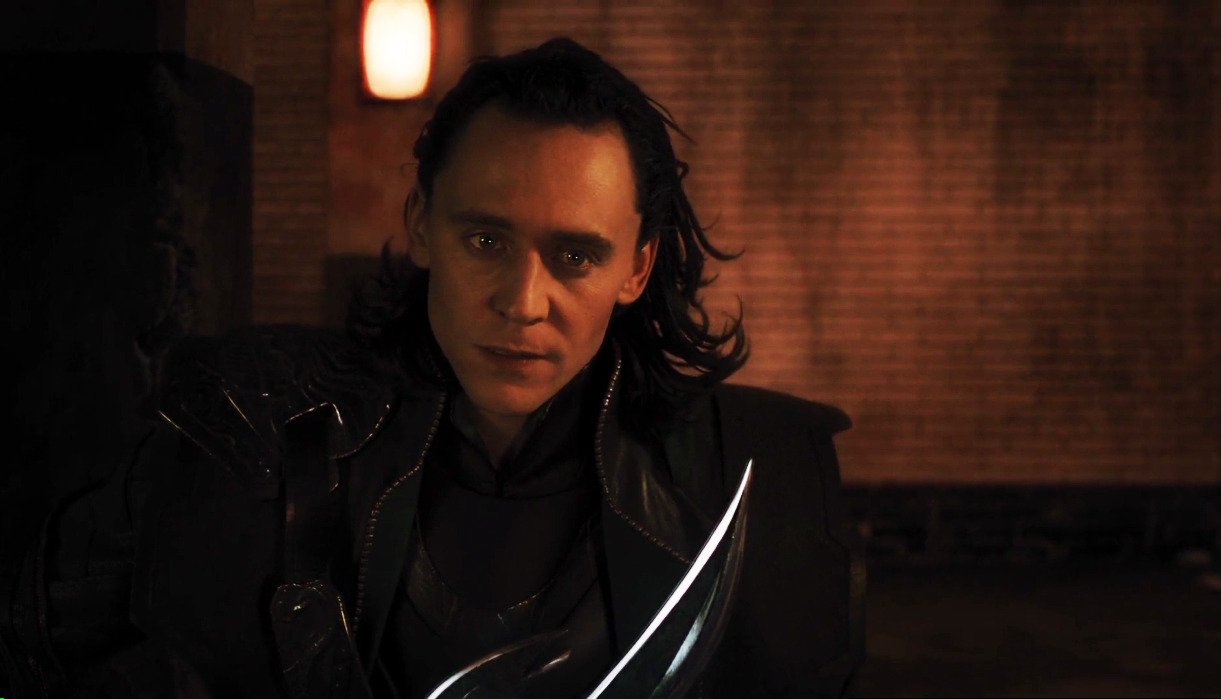
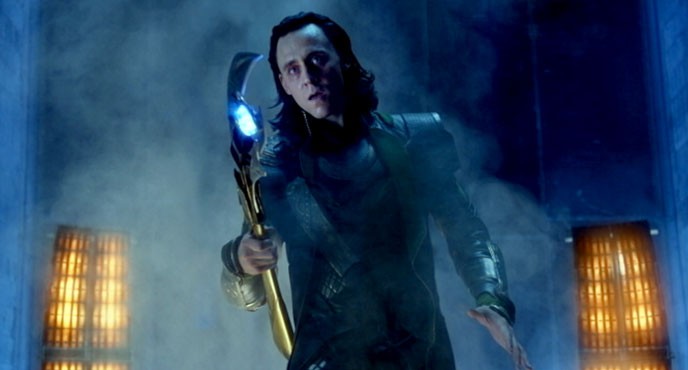
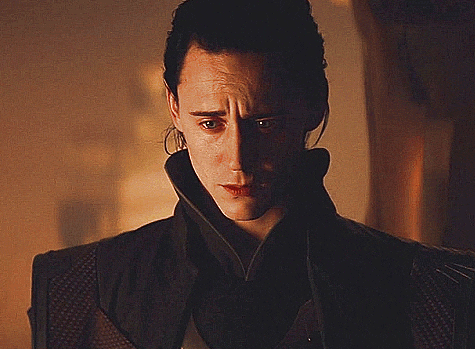
Ever since The Avengers, people have theorized that Loki intentionally botched his mission on Earth. Of course, just as many people think "failing for a grander scheme" gives Loki too much credit, and I, for one, think the theory gives Joss Whedon too much credit. Still, when you look at the facts, Loki failing on purpose is not as crazy as it sounds. First of all, Loki hates the Chitauri. He makes it perfectly clear how he feels about them ("I don't threaten," he says as he points the scepter in the Chitauri general's face). On the other hand, Loki seems to fear Thanos, going so far as to practically cry like a little bitch when the Chitauri tell him what will happen if he fails:


"I AM SO FUCKED!"
                      - The God of Mischief

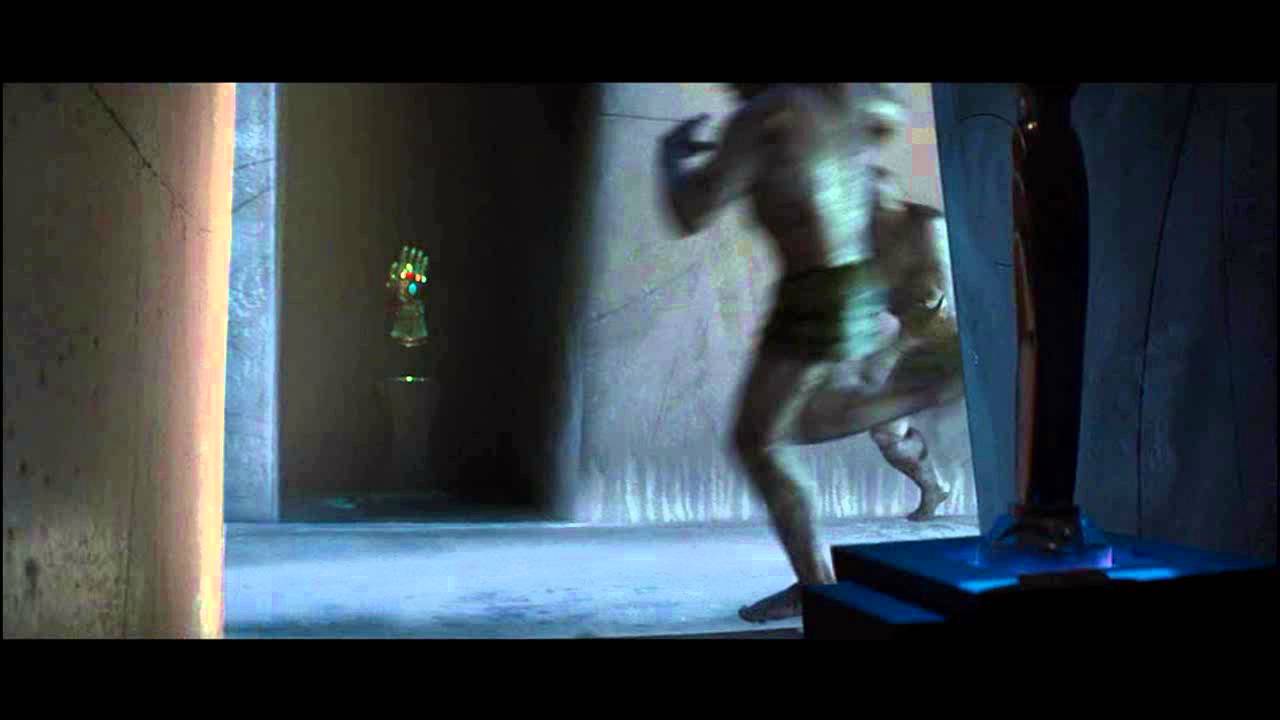
But what does Thanos actually want? Well, The Avengers tells us he wants the Tesseract, but fans of the comics know that's a pile of bull. It's not until the mid-credits scene of Thor: The Dark World that the pieces start coming together. The Tesseract is one of six infinity stones, and the Aether is another. I'd bet my left boob that Loki's scepter is the third one (god I hope I'm right). So why does Thanos want the infinity MacGuffins? Because the six stones fit into something called the Infinity Gauntlet, which can be seen in the weapons vault in the first Thor movie:

Those idiot Frost Giants just ran right past it!

So at the end of The Avengers, Loki's sent back to Asgard with the Tesseract, which is... exactly what Thanos would want, right? Loki had to fail in order to get back to Asgard. The only flaw in the plan is that Loki's sent to prison and loses access to the weapons vault. Still, it's safe to assume Loki knew he could slither his way out of jail. Remember when Tony Stark told Loki, "There's no throne. There is no version of this where you come out on top"?

GUESS AGAIN, BITCHES:

"THIS SEAT'S TAKEN."
                               - The motherfucking king

Okay, so now we've got Loki on the throne. He's dismissed Thor to Earth and gained unlimited access to the weapons vault. Loki's put himself in the Prime Puppet-master position. The question is... is he being puppeteered himself? And whose side is the Collector on? Here are my three shit-hits-the-fan theories:


Theory #1:

Loki and the Collector are assholes and give Thanos everything he wants.

This assumes Loki sent the Aether to the Collector because they're in cahoots.

That's definitely a face you can trust.

If Sif and Volstagg went to the Collector with one of the most dangerous weapons in the universe, we can only assume it was on Loki-dressed-as-Odin's orders. The Collector did say, "one down, five to go," in an ominous voice, so it's safe to assume he's up to no good. So Loki and the Collector sit on/gather the infinity stones, and then Loki hands the Infinity Gauntlet and the stones over to Thanos like it ain't no thang. This will probably lead to Thanos trying to destroy the universe and the Avengers having to whoop his ass in Avengers 3.

The complicated twist: The possibility that Thanos has been using the scepter on Loki and Loki's not fully in control of his actions. There's a lot of evidence to support this twist, including Loki's bright, blue eyes in The Avengers, the fact that he seems to remember the events of Thor incorrectly ("I remember you tossing me into an abyss!"), and his very out-of-character speeches about the joys of giving up freedom.

"Freedom is life's great lie."
                                        - The guy who loves freedom

Thor, who's not really as dumb as people think, hits the nail on the head in The Avengers when he asks Loki, "who controls the would-be king?!" and Loki doesn't even answer the goddamn question.


Theory #2:

Loki and the Collector are opposed to Thanos, and Loki's secretly trying to save the universe.

This theory's a lot of fun to think about. Let's assume Loki hates Thanos. Loki seems afraid of Thanos, and if Thanos did use the scepter on him, Loki's probably pretty resentful. A lot of people theorize that the scepter's spell was broken when Loki got Hulk-smashed (since "cognitive recalibration" was the only thing that snapped Hawkeye out of it). If that's the case, Loki might have taken the throne of Asgard to put himself in a position to stop Thanos, and then sent the Aether to the Collector to keep it out of Thanos' hands.

However, since Thanos is pretty much guaranteed to be the villain of Avengers 3, this theory only works if Loki fails spectacularly again.


Theory #3

Whether or not the Collector is opposed to Thanos is irrelevant because Loki plans to usurp Thanos and become the Grand Master Asshole himself.

In this theory, Loki is the ultimate supervillain. He'll help Thanos gather everything he wants - all the stones and the Infinity Gauntlet - and then snatch them up for himself. In this scenario, Loki probably destroys Thanos - along with a galaxy or four.

Which would mean that in this scenario...

Loki initiates Ragnarok.

In both Norse mythology and the comics, Loki is the harbinger of Ragnarok - the Norse Apocalypse. If Loki gains the infinity stones and puts them in the gauntlet, he'll have enough power to destroy all the things. This plot path is insane, so I have my doubts about whether or not Marvel will be ballsy enough to attempt it. I did some research online, however, and found this quote from Thor actor Chris Hemsworth about the upcoming Marvel movies:

"I think that in the comic book the sort of end of days, Armageddon aspect is probably the direction [the movies] will all head in."

So, um...

Shit.

Sure hope the Guardians of the Galaxy movie will shed some light on where the goddamn fuck this is all going..........

Comments? Thoughts? I'd love to hear what others think!


Wednesday, August 14, 2013

A Devil on the Shoulder: Loki and Impossible Redemption

After a long absence in which I moved my entire life across the Pacific Ocean, I'm finally back with an overblown ramble.  Today's topic?  Loki.  We all knew it was coming.

Quick note on spoilers: Any mention of the Journey into Mystery comic series will be spoiler-free.  I won't bring up or discuss any aspect of the story that ruins its final act.  However, all Marvel movies will be discussed under the assumption that everybody seen that shit already!

So, ever since the release of the first Thor: The Dark World trailer, the name on everyone's lips is Loki, Thor's adopted brother and the God of Tumblr.  Will Loki aid Thor in the new movie?  Will he turn traitor?  Can Loki even be redeemed?  That's what I'm here to talk about.  I recently wound up diving into (and became totally addicted to) the Kid Loki saga of Journey into Mystery.  While I was reading the series, I found a lot of parallels between the character of Kid Loki, and the film character he was loosely based on.

First things first, for those of you who don't know who Kid Loki is, or why he's a "kid," let's introduce the adorable little rascal.  In the world of Marvel comics, Kid Loki is the reincarnation of the deceased adult Loki, and an overly enthusiastic rider of demons and maker of rude hand gestures:

"L" is for "LOOK OUT, IT'S A FUCKING HELL DEMON!"
Here's what happened in as much of a spoiler-free manner as possible: prior to Kid Loki's run in Journey into Mystery, evil adult Loki staged one of his usual, villainous blowouts: banish Thor, become the new king's councilman, destroy all of Asgard  - y'know, a typical Tuesday for Loki.  At the last minute, however, Loki had a change of heart for unknown reasons and sacrificed himself to save Thor and the Avengers and (what was left of) Asgard.  So... that was pretty much unexpected.  Even though Loki died a hero's death, very few mourned his passing - besides Thor, who couldn't cope with the loss of his brother - even if his brother was a known fucktwit.  In an unexpected and totally inexplicable twist, Thor decided to resurrect Loki from the dead (which was only possible because, as it turned out, the trickster had taken certain precautions before his death that allowed his soul to be reincarnated).  Anyways, Loki's soul - or whatever the hell Norse gods are made of (rainbows and Pantene?) - was reincarnated into a French preteen boy.

No, I'm serious.
Thor sought out the little French Loki and restored him to his, er... former glory (yes, that's an MCU Loki reference, shut up).  In almost every way that counts, Kid Loki is Loki, just a... reduced Loki.  He has no memories from beyond childhood, and he's been reset to a time before he became evil.  You could go so far as to say he was reborn with "original sin," and Loki is literally given a second chance to redeem himself.  Unfortunately, everyone in the known universe still remembers Loki as an insufferable, cocky asshole, and the fact that he's now a cute, cuddly little boy with an internet addiction isn't going to change their view of him.  All the innate building blocks that turned Loki into a fucking asshole are still there... the question is: will Loki use them?

The fact that everyone except Loki remembers Loki's evil deeds makes his attempts at redemption extremely difficult.  His memories are wiped clean, but there's no escaping what he's done.  In other words, Loki doesn't get a free pass just because he's born again.  In fact, Loki can't escape who he was at all.  His run in the Journey into Mystery comic series starts off with Kid Loki having a confrontation with the remnant spirit of none other than adult Loki himself, wearing his finest furs and his most disgusted expression.
 
"I mean, really, kid?!  A hoodie?!  I thought I taught you better than this!"
 
Kid Loki has no choice but to face his bitter past.  Ultimately, he decides he wants to be the one and only Loki, and that he wishes to banish away the evil temptations of his former self.  To put it simply: Loki wants to be good.  At his core, free from the suspicious glares of others, Loki has no desire to be evil.  In the end, Kid Loki reduces his adult spirit into the body of a magpie and names the bird Ikol (Loki backwards, obviously).  Ikol's job is to share adult Loki's knowledge and wisdom with Kid Loki and guide him through his new life (yeah, that can't possibly go wrong).  In other words, Loki has a literal devil on his shoulder - and that devil is Loki himself.

"Caw-caw, motherfuckers."
Kid Loki's internal conflict over whether or not to become evil is depicted in an external fashion.  His past sits on his shoulder - a constant reminder of what he used to be.  There are many times, in fact, in which Loki is forced to choose between Ikol's cruel wisdom and Loki's own desire to do the right thing.  For example, there's scene in the comics in which Loki is ordered to kill a vicious puppy from a litter of Hel-dogs.  While Loki stands above the World Tree preparing to toss the (fire-breathing and perpetually-swearing) puppy into the abyss, Ikol perches nearby, encouraging Loki to do it.

Says the eyeless, talking bird.
What's interesting about this scenario is that Ikol (who is really just adult Loki) echoes the sentiments of all the other people in Loki's life.  While it may seem evil to throw a puppy into an abyss, Ikol is telling Kid Loki to do exactly what everyone else considers the right thing.  In fact, it's one of the rulers of Asgard who tells Loki to kill the puppy because...


To her credit, this is the puppy:

Such a good boy!  Yes he is!  Who's a shmoopy whoopy cutie pie?!
Loki's defense of the Hel-dog shows that, at his center, Loki is sometimes more good than the "good people" around him - or at least more righteous.  If we peer even deeper into this rabbit hole, those "good people" may have actually led to Loki's corruption in the first place... which is where the parallels between Kid Loki and movie Loki begin to show.  If we think of Ikol as the echo of adult Loki's inner thoughts, there are some very interesting things that can be observed.  For example, there are times when Ikol discourages Kid Loki's reformed behavior because Ikol simply can't accept that Loki might actually have an innate capacity for goodness.

You're stupid!


At times, the echo of Ikol's jealousy towards Thor is so strong that it continues to rear its ugly head even from beyond the grave - and, thus, threatens to corrupt young Loki with the same darkness that led Loki to become his brother's arch-nemesis in the first place.  When Loki attempts to do good, Ikol doesn't even see it as worth the effort because, deep down, he bitterly believes Thor could do it better.


What starts to become clear here is that Loki internalized his own self-hatred so deeply, it follows him into death.  Now, he projects that self-loathing onto his own reincarnation.  Loki creates his own cyclical corruption.  So where did all this self-hatred stem from?  Well, everyone in Loki's life believes it's "inevitable" that Loki will become evil.  If that sounds a little off, well, it is.  I should point out that the comics tells us adult Loki was not originally evil, even when he was older than Kid Loki.  The very same people who mistrust Kid Loki  openly admit to a time when the original Loki was older than Kid Loki and not evil.  Volstagg - who completely mistrusts Kid Loki - has no problem admitting to a time when Loki was still a good man:
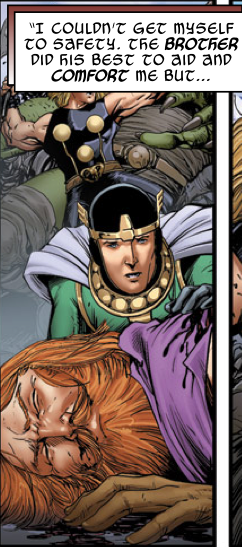
He has a name, you know.  Gawd, no wonder he grew up to hate you.
Even the normally reasonable Sif goes so far as to say she's sure Kid Loki will grow up to become the same evil man he was before he died, even though Kid Loki's done absolutely nothing wrong that she knows of.

So what does any of this have to do to do with the Loki of the Marvel movies?  Well, I think Loki's descent into evil actually mirrors Kid Loki's story in several ways.  Movie Loki doesn't seem particularly evil when the film opens - I mean, yes, he let the Frost Giants into the weapons vault, but it doesn't seem like that level of trickery is a normal activity for him.  No one else in the film ever speaks of any previously evils deeds that he's done.  It's possible the film failed to develop Loki's past due to lack of time or focus, but considering the fact that Thor and his friends don't seem the slightest bit concerned about having Loki join them on dangerous missions leads me to believe that Loki hasn't done anything yet to earn extreme mistrust.  In other words, just like in the comics, we're led to believe that a teenage-to-early-adult Loki isn't necessarily evil.  Yet, just like in the comic books, there's an assumption on the part of virtually everyone that Loki will go the way of douchebaggery.  There are many moments in the Thor movie in which Loki is convicted of wrongdoing for seemingly no reason.  For example...

#1: Loki tries to convince Thor and his friends not to go to Jotunheim, yet Hogun doesn't even hesitate to point a finger at Loki when they talk about who let the Frost Giants into the weapons vault.

While it's later revealed that Loki actually did let the Frost Giants into the vault, there's absolutely no reason why anyone should've suspected him.  When Thor wanted to go to Jotunheim, it was Loki who urged him not to.  Thor and his friends had no problem breaking the law, while Loki was the one trying to do the right thing.  Then, when Thor and his friends ignored Loki's advice and went to Jotunheim anyways, they started a goddamn war.  This, after Loki continually said they should leave before the crisis escalated.  During the battle with the Frost Giants, Loki even saved Fandral's life and helped assist everyone to safety, and yet the moment they're back home treating their wounds, Hogun doesn't waste even a goddamn second before accusing Loki of letting the Frost Giants into the vault.  Even the word "treason" is thrown around!  Um, 'scuse me, Hogun?  I was just wondering, um... isn't accusing a prince of Asgard without any evidence technically treason?!

#2: Heimdall assumes Loki's committing evil behind his back for no reason.

Heimdall can't see Loki with his magical long-distance pervert vision, so that automatically means Loki's doing something evil, right?  That seems to be Heimdall's logic, at least.  Did Heimdall ever stop to consider the possibility that Loki was off boning someone and didn't want to be watched?  Or that Loki secretly likes to crochet in his spare time?  There are about five billion other things Loki may not want Heimdall to see him doing, yet Heimdall just automatically thinks, "the son of my king who has never acted against the crown in any way has got to be committing treason."

He was actually off modeling for Garnier Fructis.  Duh.
#3: When Loki rightfully takes the throne, everyone in the movie acts as though he staged a coup.

Which is, of course, ridiculous.  In fact, unlike #1 and #2 above, Loki actually, really, truly is innocent of this offense.  There was no reason for people to suspect he'd taken the throne by force or deception.  Odin falls into the Odinsleep all the damn time, and with Thor banished, who the hell else was going to sit on the throne?!  No one in the film knows that Loki is adopted or a Frost Giant - not even Thor.  As far as anyone knows, Loki is Odin's younger son and the next in line for the throne.  It's not like Loki killed Queen Frigga either, so unless she was imprisoned - which someone would've heard about - she obviously okay-ed the entire thing.  In fact, there's a deleted scene from Thor in which Frigga literally tells Loki he has to be king and forces the scepter on him.  He doesn't even want to be king.  In the deleted scene, this is the face Loki makes when his mother tells him he has to take the throne:

You... you mean I have to wear an even stupider hat now...?
Ultimately, both comic book Loki and movie Loki's corruption becomes a chicken and the egg conundrum.  Did Loki become evil because everyone around him assumed he would, or did everyone assume he would become evil because he would?  If no one assumed Loki was evil as a child, would he become evil nonetheless?  Or did the people around him hand him an evil crown, and the innocent child grew to fit it?  There's no easy or correct answer to that question because we'll never really know.  Even in the Kid Loki series, it's impossible to say for sure what Loki would've become in a pure environment, because the people around him still continue to suspect him of wrongdoing at every turn.  Worst of all, the magpie on his shoulder - the Loki who was led to believe himself evil by the exact same people in his former life - now starts to convince Kid Loki that the words of the others must be true.  It's kind of a mindfuck, but it's like Ikol internalized the words of the other Asgardians and came to believe he was inherently evil - thus, he can't help but encourage his reincarnation to believe that there's no other possible outcome.  We end up with two wheels of corruption turning against each other.  After all, if Loki internalizes the words of the Asgardians and starts to act out their expectations, the Asgardians become justified when they start pointing fingers.  The cycle just goes on and on, until we have ourselves a super-villain.

So all of this leads to the question: can Loki be redeemed?  Not will, but can.  How can a character be redeemed if those around him don't allow for the possibility of redemption?  Even Kid Loki himself is aware of the problem:

Testify!

The same can be said of movie Loki.  No one in Loki's life trusts him.  Loki's schemes always seem to fail, but it's not because he's the "bad guy" that he fails, it's that he's always set up to fail by those who expect the worst of him.  In the comic books, Loki's way of doing battle appears "deceptive" instead of brave, so even when he succeeds at doing something good, he doesn't succeed the way others think he should, so he fails by default.  Take a look at the following story from The Mighty Thor #12.1.  When Thor, Loki, and Sif were still in their youth, Sif got her ass captured by a giant, and Thor and Loki had to come to her rescue.  Loki set up a trap that allowed Thor to easily kill the giant, thus saving Sif's life and setting her free.  Here's the thanks Loki gets for his good deed when Sif retells the tale as an adult:


Wow.  Talk about ungrateful.  Loki saves Sif's fucking ass from a giant birdcage, and all she does is talk about what an evil monster he is because she didn't like the way he rescued her.  The way he saved her life wasn't good enough.  Wow.  I can't think of anything bitchier.  Loki did absolutely nothing wrong, but he didn't do things the way Asgard thinks they should be done, and thus he was condemned for his efforts.  Why would someone like Loki even bother doing good if that's the way he always gets treated for it?

Unfortunately, movie Loki is subjected to similar treatment.  He failed at being a king because everyone expected him to fail.  When Loki schemed to get Thor in trouble with their father, he probably didn't expect Thor to start a damn war.  However, since Thor went and did that anyways, Loki had to set things right once he was king.  He was actually cleaning up Thor's intergalactic mess.  Loki's attempted genocide of the Frost Giants is usually considered his most evil act in the movies - and it totally is - but one must also bear in mind that Laufey was the one who declared war on Asgard, and Loki had a duty to protect Asgard from that threat now that he was king.  If the scenario is look at from that perspective, Loki technically succeeded.  He killed Laufey and ended the war with Jotunheim without spilling a single drop of Asgardian blood.  The problem is that he did so through trickery, so it was viewed as an act of evil by both the Asgardians and the movie's audience.  In other words, we were told the movie's story the same way Sif told her story above, and we were goaded into sharing the Asgardian bias.  While I would never say Loki isn't a villain - I mean, seriously, genocide?!  Talk about an overreaction - I would still argue that the audience is tricked into vilifying Loki.  Just as history is told by the victors, the film's story is told to us by the heroes.  Obviously, the perspective is somewhat skewed.  I mean, Loki's the villain, right?  So anything he does must be evil... right?

Basically, the point of this entire ramble is to say: some villains are born, and others are made.  Loki may be the so-called God of Mischief, but it seems to me he was created from the ignorance of "good" people.  What makes it rather creepy in movie Loki's case, however, is that the audience becomes an active participant in this transformation.  When Thor's friends come to Loki to ask that he free Thor, we automatically take their side.  The audience is tricked into forgetting that Thor was banished for good reason, and that Loki would be breaking his own father's decree if he took it back.  We don't question Sif and the Warriors Three when they betray their king (both Loki and Odin) to return Thor to Asgard, and we don't question the fact that Heimdall betrays Loki as king either.  We just say, "oh, but they're the heroes and Loki's the bad guy" without really thinking about what's happening right in front of us.  Just like the Asgardians, we point fingers based on the role Loki was supposedly born into.  At the risk of sounding melodramatic, it's like the audience helps to create the monster.

Which brings us right back to Thor: The Dark World.  Let's face it, we're all waiting for Loki to betray Thor.  It's not even up for debate.  Thor says, "when you betray me, I'll kill you."  Not if, when.  And who could blame him?  We all know Loki will turn out to be an asshole.  We all say, "it's just Loki's nature" or "Loki's the bad guy" and that automatically means Loki will turn evil.  Trust me, I'm no different.  I'm gonna spend the entire movie waiting for Loki to shout "jk!" and go evil, and I'm gonna facepalm if Thor doesn't see it coming from a mile away.  After all, Loki's the bad guy.  That's the role he's been molded into for three films, and it might be too late to take it back.

The ultimate plot twist would be if Loki didn't betray Thor at all.

Could it happen?  Probably not.  He's the villain, after all, and that's the role that was made for him by mythology, Marvel comics, and the script writers of the movies.  Thus, it's the role the audience expects of him.  When Loki turns evil in Thor: The Dark World - and we know he will - our expectations will be met and justified, just as they are for the heroes.  Loki knows it, and he'll probably play with that sentiment for his own amusement.

His face in the trailer alone says it all:

Tee hee, you all so effed.
And that's my rambling food for thought.  It's a bit of an extreme view - one that I don't even fully believe, but I love to play devil's advocate.  Either way, I hope I was able to offer a slightly new perspective on what's become a very popular villain.

Comments?  Opinions?  Anything to add?  I'm pretty new to comic books, so if anyone has any interesting or in-depth info that I haven't mentioned, I'd love to hear it.  I'd also love to hear any counter-arguments or new takes on the situation.  Feel free to speak below!

Saturday, May 18, 2013

Reading Western Comics (A Literal "Journey into Mystery")

The entire point of this blog is to banish ignorance.

I should clarify that I mean my own ignorance.  Living in the internet age as we do, and being a fan of comic book TV shows, video games, and movies, it should be easy to learn more about the source material, right?  We have blogs, forums, encyclopedias...  All the answers are right at our fingertips!  More often than not, however, I find myself somewhat alienated by comic book veterans.  It usually goes something like this...

Me: Black Widow and Hawkeye seem to have a budding relationship in "The Avengers."  Does anyone know if that's canon in the comics?

Anonymous: Of course it is you fuck-twit.  In issue ______ of ______ they totally _________ and then __________.  How could you not know that you stupid asshole scum?!

Me: I'm... I'm sorry...?  Thank you for telling me?

Anonymous: DON'T START UP A CONVERSATION ABOUT "THE AVENGERS" UNLESS YOU'VE READ THE COMICS!  OMIGAWD U R SO DUM!!!1  GO AWAY ONLY REEL FANS WHO HAVE READ THE COMIX ALOWED!!!!!!!111oneoneone

Me: I'm really sorry, calm down!  I just haven't had a chance!

Anonymous: YOU SHOULD DIE IN A FIRE!  I HOPE YOU GET GANGRENE IN YOUR BOOBS STUPID NO ONE WHO HASNT READ THE COMIX SHOULD TALK ABOUT COMIX

Me: [commits ritualistic seppuku]

That kind of offensive attitude online isn't exactly conducive to learning.  I always feel like I'll "never know enough" even if I do try to read the comics, or else I fear becoming an asshole snob like the ones who do.

Nonetheless, this raises the question, "if I liked comic book-based media before, why am I only just picking up comic books now?"  Honestly, it has nothing to do with the holier-than-thou attitude of comic book readers online (though it's certainly not helping), and more to do with the stigma towards Western comic books that I grew up with.

MY INITIAL PERSPECTIVE

I grew up with a father who really enjoyed comic books as a child and saw nothing wrong with them, but was no longer reading them and didn't have any in the house.  Thus, I had little exposure to the "source material" of the shows and movies I was enjoying.  By the time I was eleven or so, all my male friends had moved on and I was learning how to befriend girls who absolutely hated comic book media.  I was also attending a school with an enormous Asian population, so most of my "comic" exposure was in the form of manga (of which I was a casual reader at best).  In college, I became a Japanese major, so most of my friends were strictly manga readers.  For the last few years I've been living in Japan, where Western comic books are fairly unknown (until recently, but that's a whole other topic I'll write about later).

WESTERN COMIC BOOK STEREOTYPES

Because  of the world I grew up in and the people I knew, there were certain stigmas about Western comic books that I ran into over and over again.  Because most of the boys I played X-Men action figures with drifted out of my life as a child, I was left with the feeling that "girls shouldn't read comic books."  Comic books were for boys, right?  That was reaffirmed by the fact that the girls I started to hang out with all thought that stuff was "weird" and probably covered in cooties.  I went through a pretty extensive tomboy phase, and I felt like the only way to start fitting in was to put all that stuff behind me, no matter how many times Batman Beyond made this face at me:

I'M SO SORRY BATMAN.

My little elementary school brain found it very interesting, however, that while Western comic books were seen as "manly," Japanese comic books weren't... if you knew which ones to read.  For awhile I resisted, since I didn't want to be seen as a "nerd" (I was such a fool), but I was slowly drawn into reading manga after awhile.  Despite my personal preferences (not girly), many of my friends were fully immersed in shōjo (girl's manga).  Of course, it seemed a lot of them were in it just for the art.  The difference between Western comic books and Japanese comic books, you see, is that manga is "pretty" and Western comics are "ugly."  And how could I disagree?  We've all seen what vintage comic books look like.

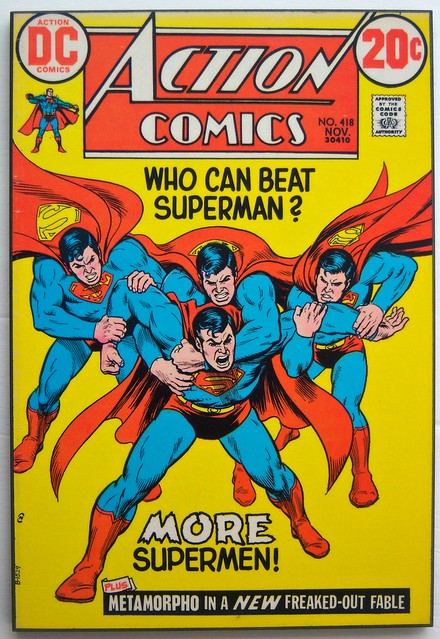
I mean, how can you compare this:

*cue a choir of singing angels*

 With this:


Uh... what.

That kind of old-fashioned comic book style was the only thing I could picture when people talked about "American comics."  Hard, rigid lines with dull, uniform colors.  Simplistic animation and awkward angles.  Maybe shōjo manga's content made me want to vomit, but I sure knew which art form I'd rather look at.

Which brings me to the next stigma: content.  On top of being "prettier" and "more artistic" than the childish animation of Western comics, it was drilled into my head over and over that Japanese comics had better stories.  With plenty of notable exceptions, Western comic books, as far as I knew, were always simple hero vs. villain stories.  Guy gets super powers, fights other guy who has super powers, guy gets girl, villain returns to commit evil because he hates Mondays.

But manga?  Oh, no, manga is all about stuff, man!  So much stuff!  Crazy stories with love trapezoids and world wars and vampires and half-demons with cat ears and robots and "omigawd, this one is such a mindfuck you have to read it."  To my child-self, this seemed to be true.  Manga didn't follow that hero vs. villain formula.  Manga heroes were just as likely to be conflicted as the bad guys, and the villains were just as likely to be sympathetic like the hero.  Moreover, it wasn't uncommon for the hero and the villain to be - gasp - siblings!  Or estranged lovers!  Or the only two remaining kin of a lost world!  Some manga didn't even have a hero or villain story line at all!  What madness!  Such absurdity!  Manga's where it's at, man!

But with age comes wisdom and, slowly, manga began to seem just as formulaic and boring to me as the Western comics the people around me scorned.  The same patterns and story lines kept reappearing so many times that I could predict every plot twist in my sleep.  Furthermore, manga wasn't really that pretty.  The big eyes and gangly limbs started to seem alien and even horrific to me at times.  Even while living in Japan, I just stopped reading manga all together.  I just couldn't get into it.

So the conclusion I reached was that both Western comics and Japanese comics (with notable exceptions) were garbage.  And then I went back to watching "Kick-Ass" in a dark room by myself where no one could see my shame.  

While I was still in Japan avoiding all forms of comics, Marvel was doing its freaky little tap dance around the movie industry and mainstreaming B-level comic book characters into stars.  In between my first year in Japan and the two years that followed, I spent a year in the U.S. and fell completely in love with Marvel's Phase 1 movies.  I remember watching "Iron Man" and "Thor" and thinking, "wow, I guess the only way to make Western comic book movies awesome is to make them not at all like the comic books they're based on.  Go team!"  After all, unlike the comics, the movies were pretty and multidimensional and interesting.  What a novel idea!

It was after "The Avengers" that I decided I really wanted to give comics a try.  At that point, I decided the movies didn't just appear in a vacuum.  They had to come from something, even if that something was no more two-dimensional than roadkill.  There had to be an inkling of that movie glory in the source material, right?

Well, thanks to Nolan's "Batman" trilogy and the Marvel Cinematic Universe, Western comic books have finally taken off in Japan (I would dare say it's becoming a fad)!  That means I finally have access to imported comic books in English (because fuck dealing with kanji, seriously).  While browsing Kinokuniya, I picked up a few issues from the Western comic book selection and glanced at the covers.  My eyes nearly bugged out of my head.  I was expecting that Superman orgy up above, but instead, I was seeing shit like this:


Did you hear that?  That was the choir of angels dropping dead from the beauty of it all.

For a moment I thought I'd been duped.  I mean, these couldn't possibly be Western comic books, could they?  So I decided it was just the covers that were pretty, because how else do you get people to buy them?  Not with Superman orgies, that's for sure.  The comics were wrapped in plastic, however, so I couldn't be sure what mysteries lay within.  I'd bought manga in the past that looked pretty on the cover and looked like Picasso took a shit on the inside, so I was prepared for the worst.

Willing to give Western comic books the benefit of the doubt, I decided to buy the above Journey into Mystery: Fear Itself as well as Journey into Mystery: Fear Itself Fallout.  Why those two?  Well, the "young Loki" saga had been recommended to me many times as an "Avengers" fan, and because I really enjoy the "Thor" cast.  I have a bit of a soft spot for fantasy, and an even bigger soft spot for villains.  If there was a degree in villaintology, I would've become a villaintologist in college instead of a Japanese major (or, if I wasn't a fucking moron, I would've gotten a degree that could help me become a writer, but Captain Hindsight needs to go away before I punch his face off).  Having been a huge fan of Tom Hiddleston's portrayal of Loki in "The Avengers," I was curious to see the primordial ooze his character sprang from.

READING A WESTERN COMIC BOOK FOR THE FIRST TIME

Alright, so I get home, and pull open Journey into Mystery: Fear Itself

My expectations: dull colors, gawky proportions, stiff artwork, cheesy dialogue, predictable story lines, black and white heroism, and excessive rolling-on-the-floor laughter on my part.  Basically, what I expected was this:

Face... palm...

I'm not saying there's anything wrong with the above comic, of course.  Back in the 1960's, that kind of material was perfectly fine.  Printing and coloring was far more difficult and limited, and there were no computers, either.  The target audience was also far younger, so the stories were simpler and more straightforward.  That's fine, but things have changed.  People demand more complex stories with more natural dialogue these days.

The problem was that I didn't think Western comic books had kept up with the times enough to change.

So imagine my shock when I opened up Journey Into Mystery volume 622 (good lord...) and saw... a beautifully painted, poetic and philosophical journey of seven magpies through the Nine Realms of Norse Mythology?

Wait, what?

I closed the book and checked the cover.  Yup, it's Journey into Mystery alright, there's the little MARVEL sticker at the bottom.  The hell's goin' on?  I returned to the story, strangely enthralled and enchanted by this lovely little tale of seven magpies and how they each perished on the glorious quest that they, themselves, did not understand.  How... delightfully charming and unexpected.  That is, until the seventh magpie reached Loki, said half a word and exploded.

Not only was I sitting there stunned by the beautiful artwork and poetic narration, I was also dying with laughter as Loki, splattered with blood, shouted, "gross!"  That... was not what I expected.  First of all, the beautiful artwork of the cover was maintained on every page of the comic book.  The story was charming, well-written, and actually funny at times!  Not funny as in, "haha, this book is so bad that I'm laughing," but funny as in "haha, this running joke is still hilarious twenty pages later."

So I read on, my eyes widening with pleasant disbelief at every page.  The story was fascinating.  There was action, drama, emotional complexity, interesting characters, humor, sadness...  In all these years, I'd never realized Western comic books could be so... intriguing.  I thought the movies were just sorta made up on the fly based off some old panels that had been thrown together, but that wasn't the case at all.  This was where it all began, right here in the pages of a comic book.

One of the things that surprised me most of all was that the things I considered "girly" in manga confidently appeared in the comic.  The protago-antagonist (seriously, I don't know what to call him) is a young Loki, and along with his youth are the fears and sorrows of any lost child.  Tom Hiddleston's Loki is known to cry a lot, but I figured this was acceptable artistic license because the movies have more emotional depth than the comics.  Imagine my surprise when I found several scenes in Journey into Mystery in which young Loki also cried for perfectly acceptable reasons.  I didn't expect Western comic books to really, well... deal with emotions, to be perfectly honest.  I thought that was a "manga" thing, but clearly, I was wrong.  The comic book I was reading had complex characters with complicated hopes and dreams, just like the characters found in Japanese comics.  Seeing Loki's teary face painted into a comic panel made me realize just how ignorant I'd been about such a popular and prevalent form of literature in my home country.  I realized I had a lot to learn.

As soon as I was done with the first book, I hungrily ate up the second.  It ended on an extremely bittersweet note that made me desperately wish I had access to the next issue.  I think I might pay for the Marvel Unlimited database so I can digitally view more comic books without paying outrageous prices.

I can safely say that, prior to actually opening a comic book, I never thought I'd be willing to pay money to see more.  So far, the artwork I'm finding in these comics is even prettier than the artwork I've found in manga (with the exception of Angel Sanctuary (天使禁猟区 ), which I'm pretty sure was drawn with the tears of newborn angels), and has a story just as complex, unique, and interesting.  Young Loki's story has no true heroes or villains, and it relies just as much on intelligence and puzzle-solving as it does on action sequences.  I never expected that in a million years.

And now I'm just left wondering why I didn't read Western comic books sooner.  I've missed out on so much.

So now that I've opened the door, I'm going to walk right on in and have myself an awesome time.  I'm going to continue reading comic books and writing "articles" on this blog about the interesting things I discover on my journey into becoming less of a n00b.  I hope it'll be a fascinating experience! 

Any thoughts or opinions on my "Journey into Mystery?"  Similar experiences or interesting information to add?  Feel free to say whatever you'd like in the comments!  Comments are always welcome!

As a final bonus, here's my dog being vanquished by Thor's hammer:

He was a good sport :-)  Special thanks to my dad for getting the dog to lay still.

See y'all next time!